HEC Makes 3-Credit-Hour AI Course Mandatory for Undergraduate Students in Pakistan
HEC has made a 3-credit-hour Artificial Intelligence course mandatory for undergraduate programmes across Pakistan, strengthening AI literacy and future-ready digital skills among university students.
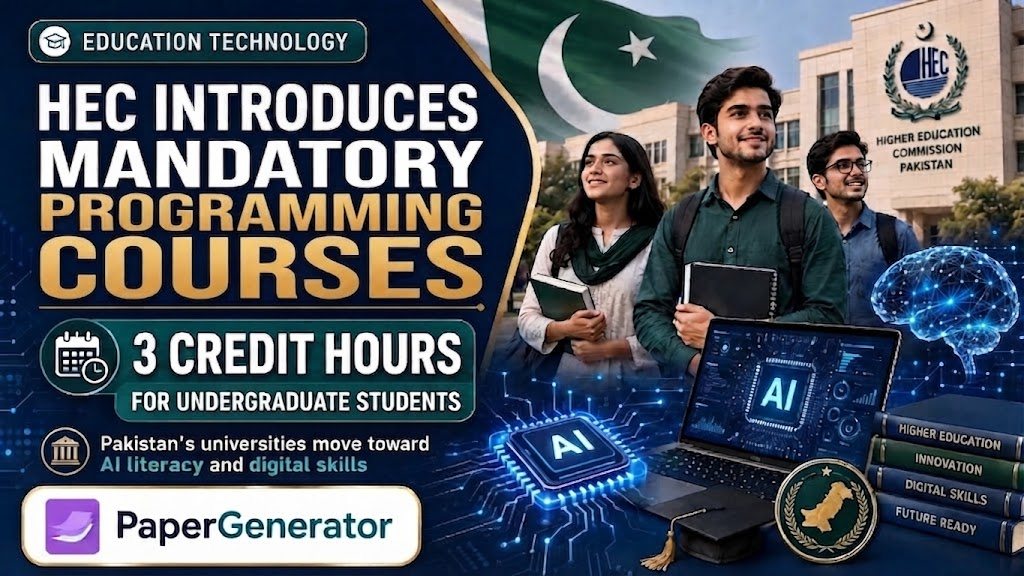
Pakistan's higher education sector is taking another significant step toward digital transformation. The Higher Education Commission (HEC) Pakistan has made a three-credit-hour Artificial Intelligence course mandatory for undergraduate programmes across universities in the country.
The reform reflects the growing importance of Artificial Intelligence, digital literacy and emerging technologies in education and employment. Students studying disciplines outside Computer Science and Information Technology will also increasingly need a basic understanding of AI as these technologies become part of healthcare, business, engineering, education, finance, media, agriculture and many other industries.
HEC Chairman Prof. Dr. Niaz Ahmad Akhtar confirmed the initiative during a higher education reform briefing in March 2026. According to HEC, the mandatory course is intended to provide students from different academic disciplines with foundational knowledge of emerging technologies and help prepare graduates for the changing demands of the digital economy.
For students, universities and teachers, the announcement is important because AI education is no longer being treated only as a specialist subject for computing students. It is increasingly becoming a basic academic competency that graduates from different fields may be expected to understand.
Students and universities can follow official policy developments through the Higher Education Commission Pakistan website.
What Has HEC Announced?
HEC has announced that a three-credit-hour Artificial Intelligence course will become part of undergraduate education across universities in Pakistan.
The key features of the reform include:
- 3 credit hours of Artificial Intelligence education
- Mandatory inclusion in undergraduate programmes
- Coverage for students from different academic disciplines
- Focus on foundational AI knowledge
- Preparation for the digital economy and future job market
- Greater integration of emerging technologies into university curricula
HEC's official March 5 announcement described the course as part of wider higher education reforms intended to make Pakistan's universities better aligned with national needs and global technological trends.
Students interested in the policy background can read updates directly through the official HEC Pakistan website.
When Will the Mandatory AI Course Start?
HEC's March announcement confirmed the mandatory undergraduate requirement, while later implementation announcements indicate that universities are preparing to introduce the AI course from Fall 2026.
For example, the University of Chakwal approved a mandatory three-credit-hour AI course in line with HEC directives for implementation from Fall 2026.
Government College Women University Sialkot also announced implementation of the policy from Fall 2026.
Students should therefore check their own university's scheme of studies, academic office or departmental notifications, because exact semester placement and implementation arrangements can vary by institution.
Why Is HEC Making AI Education Mandatory?
Artificial Intelligence is rapidly changing how people study, work and make decisions.
AI tools are already being used in areas such as healthcare diagnosis, financial analysis, software development, scientific research, digital marketing, education, manufacturing and business automation.
This means AI knowledge is becoming relevant even for students whose degrees are not directly related to computing.
A business student may encounter AI-powered analytics. A healthcare graduate may work with AI-assisted clinical technologies. An engineering student may use intelligent automation, while teachers may increasingly work with AI-supported learning systems.
By introducing a mandatory AI course, HEC is attempting to give graduates a common foundation for understanding these technologies rather than limiting AI knowledge to Computer Science students.
What Could Students Learn in the AI Course?
The exact syllabus may depend on HEC curriculum guidance and individual university implementation.
However, official public information on HEC's AI education direction indicates a focus on fundamental AI concepts, interdisciplinary applications and ethical considerations.
Students could therefore encounter areas such as basic Artificial Intelligence concepts, machine learning awareness, generative AI, responsible AI use, applications of AI in different industries, data privacy and the social impact of intelligent technologies.
The goal for non-computing students is unlikely to be turning every graduate into an AI programmer.
Instead, the course can help students understand what AI is, what it can do, where it should be used carefully and how it may affect their future profession.
AI Skills Are Becoming Important Beyond Computer Science
Artificial Intelligence was once viewed mainly as an advanced Computer Science subject.
That situation is changing rapidly.
Today, AI applications can be found in almost every major sector.
In healthcare, AI can support medical imaging and clinical decision-making.
In business, AI can analyse customer behaviour and automate repetitive tasks.
In education, AI can support personalised learning, question generation and academic analysis.
In engineering, AI can help with automation, predictive maintenance and intelligent systems.
In media and design, generative AI can assist with content creation and creative workflows.
This is why basic AI literacy can be valuable even for students who never intend to become software developers.
HEC's Wider Focus on Future Skills
The mandatory AI course is not an isolated development.
HEC has introduced several reforms aimed at improving the employability and practical skills of university graduates.
In 2025, HEC announced that professional internships and industry-relevant certifications would become mandatory components of undergraduate degree programmes.
HEC has also introduced the National Skill Competency Test for IT graduates, developed in collaboration with the Ministry of IT and Telecommunication, Pakistan Software Export Board and P@SHA.
In July 2026, HEC organised a national workshop focused on quality computing education and future skills, highlighting AI integration, Outcome-Based Education and industry readiness.
Together, these initiatives show that higher education policy is increasingly focused on skills, technology and employability, rather than degree completion alone.
What Does This Mean for Non-IT Students?
The most significant part of the policy is that students do not necessarily need to be enrolled in Computer Science, Software Engineering or Artificial Intelligence programmes to study AI.
Students in disciplines such as:
Business and Management
Economics
Social Sciences
Engineering
Media and Communication
Education
Natural Sciences
Health-related programmes
Arts and Design
may also encounter AI education as part of their undergraduate degree.
This interdisciplinary approach recognises that AI is increasingly being used across professions.
A future manager should understand how automated decisions work. A journalist should understand generative AI and misinformation. A teacher should understand AI-assisted learning, and a researcher should understand how AI tools can influence analysis.
Responsible and Ethical AI Use Will Be Important
Making students familiar with AI should involve more than teaching them how to use popular tools.
Responsible AI education is particularly important.
Students need to understand issues such as data privacy, plagiarism, bias, misinformation, intellectual property and excessive dependence on automated systems.
Universities will therefore need to balance practical AI skills with responsible academic use.
Students should understand that AI can assist learning and productivity, but it does not remove the need for critical thinking, subject knowledge and independent academic work.
What Universities Need to Do
Introducing a mandatory course across different undergraduate programmes requires universities to prepare academically and administratively.
Institutions may need to:
develop or adopt an approved syllabus, train faculty, determine which semester will include the course, update schemes of studies and ensure students have access to appropriate digital resources.
Universities may also need to adapt the course according to the needs of different disciplines.
For example, the practical examples used for a Business student may differ from those used for an Engineering or Education student even when the fundamental AI concepts remain similar.
What Students Should Do Now
Students should first check whether their university has issued an official notification regarding the AI course.
Those beginning or continuing undergraduate degrees during the 2026 academic cycle should review their updated scheme of studies.
Students should also begin developing basic AI literacy independently.
Learning the fundamentals early can make the university course easier and help students use AI tools more effectively and responsibly.
However, students should avoid relying exclusively on AI-generated answers for academic work.
Understanding concepts personally remains essential.
AI Education and Pakistan's Digital Economy
HEC has linked the mandatory course with the changing requirements of the digital economy.
This is significant because graduates increasingly compete not only in Pakistan's local employment market but also in remote, international and technology-driven work environments.
Employers may increasingly expect graduates to understand automation, AI-assisted productivity and data-driven decision-making.
A graduate who understands how to work effectively with technology can have an advantage over someone who has never developed these skills.
The policy therefore has potential implications beyond university classrooms.
How GeneratePaper Supports Digital Education
The growing role of AI in higher education forms part of a wider transformation in how students learn and prepare for examinations.
GeneratePaper supports this digital education environment by helping students, teachers, schools and academies create structured examination and practice papers online.
Students preparing for university admissions can explore GeneratePaper's Entry Test Preparation section, which includes online MCQ practice and PDF paper generation for tests such as USAT, HAT, LAT, NAT, GAT and other Pakistani entry tests.
Explore GeneratePaper Entry Test Preparation
GeneratePaper also allows teachers and students to create educational papers digitally by selecting subjects, chapters, topics and paper patterns.
As educational systems become more technology-driven, tools that make learning and assessment more organised can complement broader initiatives such as HEC's AI curriculum reform.
AI Should Strengthen Learning, Not Replace It
The introduction of AI education does not mean students should stop developing traditional academic skills.
Critical thinking, writing, mathematics, communication, research and subject expertise remain essential.
AI works best when students understand the subject well enough to evaluate the information produced by technology.
The strongest graduates will likely be those who can combine human judgement and professional expertise with responsible use of AI tools.
A Major Step Toward Future-Ready Graduates
HEC's decision to make a three-credit-hour Artificial Intelligence course mandatory for undergraduate programmes represents a significant change in Pakistan's higher education landscape.
It signals that AI literacy is moving from being a specialised technical skill toward becoming a broader graduate competency.
The reform also fits HEC's wider focus on digital transformation, Outcome-Based Education, professional skills, internships and industry readiness.