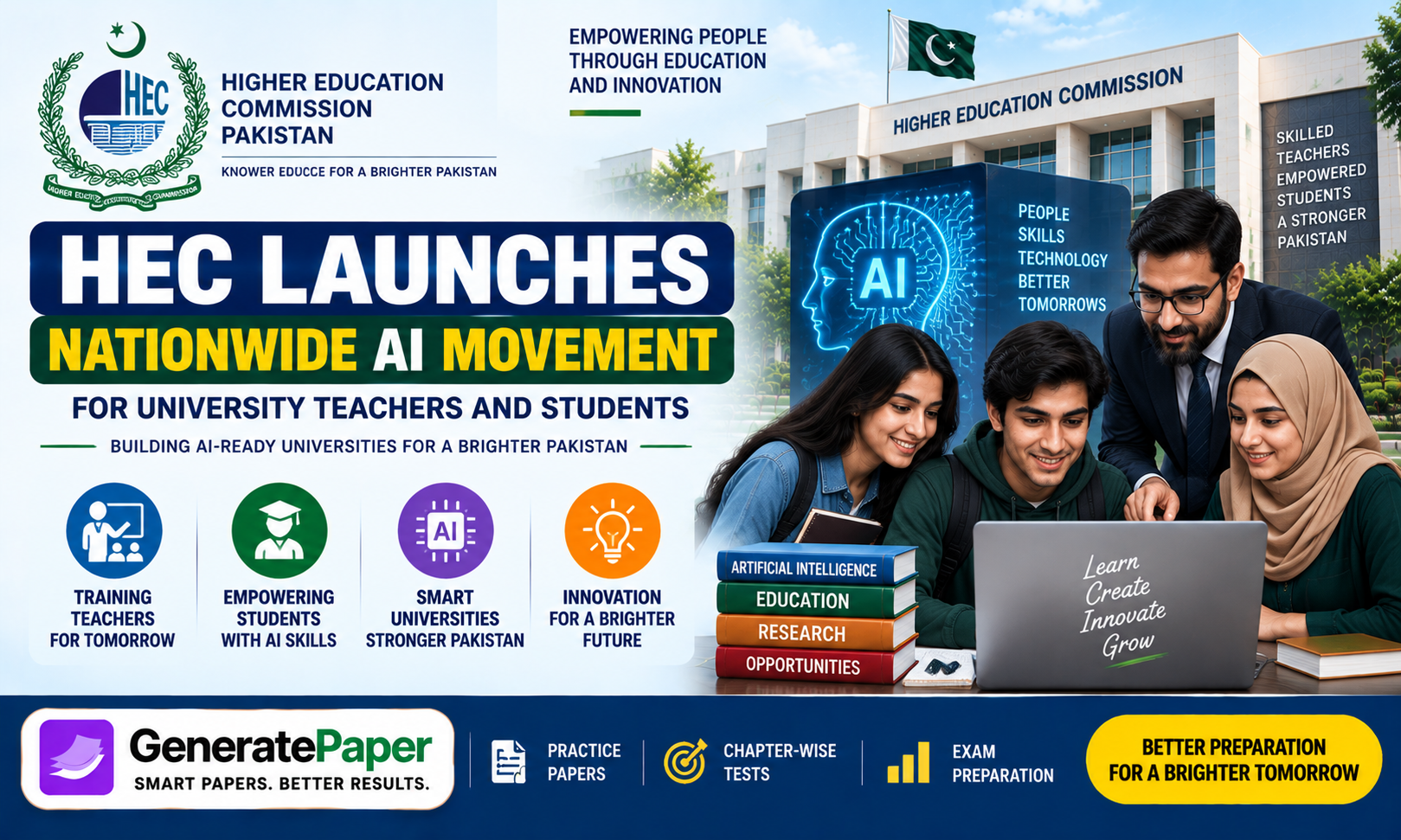
HEC Launches Nationwide AI Movement for University Teachers and Students
HEC is accelerating AI education across Pakistan through nationwide student training and faculty development programmes designed to build AI-ready universities and a future-ready workforce.
Artificial Intelligence is rapidly changing education, employment and almost every major professional field.
Recognizing this transformation, the Higher Education Commission (HEC) Pakistan is expanding Artificial Intelligence education and training across the country's higher education sector. The initiative is not limited to computer science students. HEC is working to build AI awareness and practical capabilities among university students, teachers and academic institutions, helping Pakistan prepare for an increasingly AI-driven economy.
Recent HEC initiatives include the ACT AI student training programme, which selected 6,000 students for its first cycle, as well as a nationwide faculty development programme focused on building AI-ready higher education institutions.
Why Is HEC Focusing on Artificial Intelligence?
Artificial Intelligence is becoming increasingly important across education, business, healthcare, engineering, finance, research and other professional fields.
HEC has emphasized that students from different academic disciplines need foundational knowledge of emerging technologies so they can adapt to changing professional requirements.
HEC Chairman Prof. Dr. Niaz Ahmad Akhtar has also stated that the Commission is pursuing AI-related reforms to prepare graduates for the evolving demands of the digital economy.
This means AI education is increasingly being viewed as a skill relevant to students beyond traditional computing programmes.
AI Education for Students Across Pakistan
One of the major components of HEC's AI initiative is the ACT AI programme.
ACT AI stands for Awareness, Competency & Tools Training for Artificial Intelligence.
The programme was established through collaboration between:
- Prime Minister's Youth Programme
- Higher Education Commission
- NAVTTC
- AI SkillBridge
The national initiative was designed to provide university students with practical AI knowledge and skills relevant to the digital economy.
6,000 Students Complete ACT AI Training
The first ACT AI cycle achieved significant participation.
According to HEC, more than 82,000 applicants competed for inclusion in the first cycle, while 6,000 students were selected following a merit-based assessment.
Among the selected participants:
- 5,800 completed the programme as AI-ready graduates
- 200 participants were designated as master trainers
- Students participated through HEC's Smart Classroom network
- Participants came from different parts of Pakistan
The programme was designed to give young people practical exposure to AI and prepare them for emerging opportunities.
HEC's official announcement also confirms that ACT AI Cycle-1 was an eight-week AI training programme delivered through the HEC Smart Classroom, with 6,000 students completing the programme.
What Do Students Learn Through AI Training?
The ACT AI programme focuses on practical and future-oriented AI skills.
Its curriculum is structured around areas including:
- Foundations of Artificial Intelligence
- AI applications across sectors
- AI for economic empowerment
- Future of AI
- National preparedness
The programme also covers areas such as generative AI, AI productivity tools, automation and AI applications in different sectors.
This approach moves beyond simply teaching students what AI is and focuses on how AI can be applied in real-world situations.
AI Skills Beyond Computer Science
One of the important aspects of the initiative is its broader academic reach.
AI is no longer relevant only to computer science students.
Students studying:
- Business
- Medicine
- Engineering
- Education
- Social sciences
- Agriculture
- Economics
- Media
- Law
may also encounter AI applications in their future careers.
HEC has therefore emphasized the importance of foundational AI knowledge across academic disciplines.
HEC Is Also Training University Teachers
AI transformation cannot happen through students alone.
University teachers also need to understand how AI is changing:
- Teaching
- Learning
- Research
- Assessment
- Curriculum design
- Academic administration
To address this need, HEC's National Academy of Higher Education (NAHE) conducted a four-day programme titled “AI Literacy for Educators: Building AI-Ready Institutions.”
The programme was specifically designed to strengthen faculty members' ability to understand, critically evaluate and integrate AI into teaching, learning, research, assessment and wider academic practices.
More Than 332 Faculty Members Participate
The HEC faculty programme brought together more than 332 faculty members from public-sector higher education institutions.
According to HEC, 32 faculty members participated in person at the HEC Smart Classroom in Islamabad and Rawalpindi, while more than 300 faculty members joined through university Smart Classrooms and Video Conference Rooms.
This technology-enabled model allowed universities in different locations to participate in the same training programme.
What Is AI Literacy for Educators?
AI literacy involves much more than simply knowing how to operate an AI tool.
According to HEC, the faculty training focused on helping educators understand, critically evaluate and integrate AI into:
- Teaching
- Learning
- Research
- Assessment
- Academic practices
The programme combined conceptual learning with practical hands-on activities and critical reflection.
This is particularly important because universities need educators who can use AI responsibly while maintaining academic quality and human judgment.
HEC Smart Classrooms Support Nationwide Training
A major part of the AI movement is HEC's Smart Classroom network.
Instead of requiring every participant to travel to one location, HEC can use connected Smart Classrooms and Video Conference Rooms to deliver training to participants at different universities.
This model can help expand access to specialized training while maintaining synchronized instruction.
HEC has already used this network for both student and faculty AI programmes.
AI and the Future of University Education
Artificial Intelligence is changing the way knowledge is created, taught, assessed and researched.
HEC's recent faculty programme specifically highlighted the transformative impact of AI on higher education.
Universities may increasingly need to rethink:
- How courses are designed
- How students conduct research
- How assignments are assessed
- How academic integrity is maintained
- How AI tools are used in classrooms
- How graduates develop workplace skills
AI literacy can therefore become an important component of modern university education.
Responsible Use of Artificial Intelligence
The rapid growth of AI also creates new responsibilities.
Students and teachers need to understand that AI should not simply replace human thinking.
HEC's faculty training emphasized the importance of maintaining:
- Academic quality
- Ethical principles
- Human judgment
- Institutional responsibility
when adopting AI technologies.
This is especially important in academic environments where originality, research integrity and responsible use of information are essential.
AI and Employment Opportunities
The AI movement is also closely connected with employability.
Students who develop AI-related skills may be better prepared for emerging opportunities involving:
- Artificial intelligence
- Automation
- Data analysis
- Software development
- Digital marketing
- Research
- Entrepreneurship
- Freelancing
The ACT AI programme was specifically designed to prepare participants for AI-enabled employment, freelancing, entrepreneurship and participation in the global digital economy.
Building a Future-Ready Workforce
Pakistan's digital economy requires graduates who can work with emerging technologies.
HEC's AI initiatives are part of a broader effort to strengthen digital skills and prepare young people for changing workforce requirements.
The government has also announced broader national AI goals, including investment in the AI sector and expansion of AI-related education and skills development.
AI Across Different Academic Fields
Artificial Intelligence can be applied to almost every major field.
Healthcare
AI can assist with medical research, diagnostics and healthcare technologies.
Engineering
Engineers can use AI for automation, simulation and optimization.
Business
AI can support data analysis, customer service and decision-making.
Education
AI can support personalized learning, assessment and educational content.
Agriculture
AI can contribute to crop monitoring, prediction and resource management.
Finance
AI can assist with data analysis, risk assessment and automation.
This cross-disciplinary potential explains why AI literacy is becoming increasingly important for university students.
HEC's Mandatory AI Course Initiative
HEC has also announced the integration of a three-credit-hour Artificial Intelligence course into undergraduate degree programmes.
The initiative is intended to provide students across disciplines with foundational AI knowledge and prepare graduates for an increasingly technology-driven economy.
This means AI education is becoming part of the wider academic transformation rather than remaining limited to specialized technology programmes.
For more information on this development, readers can also explore our related GeneratePaper article: HEC Makes 3-Credit-Hour AI Course Mandatory for Undergraduate Students in Pakistan.
How Students Can Prepare for the AI Era
Students do not need to wait for a university course to begin developing digital skills.
They can start by:
- Learning basic AI concepts
- Exploring responsible AI tools
- Improving digital literacy
- Practising problem-solving
- Learning data skills
- Developing communication skills
- Building practical projects
- Following technology developments
The most valuable approach is to combine AI tools with genuine subject knowledge.
Digital Tools Can Support Academic Preparation
AI is only one part of digital education.
Students also need regular practice and assessment throughout the academic year.
Digital platforms such as GeneratePaper can help students and teachers create structured practice papers for different subjects and examination requirements.
Students can use digital practice for:
- MCQs
- Chapter tests
- Topic revision
- Mock examinations
- Board preparation
Teachers can also create customized assessments according to their classroom requirements.
GeneratePaper for Board Examination Preparation
Students preparing for Pakistani board examinations can use the GeneratePaper Board Paper Generator to create practice papers.
Regular practice can help students:
- Identify weak areas
- Improve time management
- Become familiar with question formats
- Strengthen revision
- Prepare for examinations more systematically
Digital assessment tools can complement classroom teaching and help students maintain consistent practice.
AI Should Support Learning — Not Replace It
Students should remember that technology is a learning aid, not a replacement for understanding.
Using AI responsibly means:
- Checking information
- Understanding concepts
- Citing appropriate sources
- Completing original academic work
- Following university rules
- Maintaining academic integrity
Teachers also have an important role in guiding students toward responsible technology use.
The Role of Universities
Universities will be central to Pakistan's AI transformation.
They can contribute by:
- Training faculty
- Updating curricula
- Establishing AI laboratories
- Supporting research
- Developing industry partnerships
- Encouraging innovation
- Providing practical learning opportunities
HEC's current programmes demonstrate an effort to strengthen these capabilities at a national level.
Pakistan's Growing AI Ecosystem
The HEC initiatives are part of a broader national focus on Artificial Intelligence.
The Indus AI Week official platform describes Indus AI Week as a government-led national AI movement bringing together government, industry, academia, talent and innovation.
At the higher education level, HEC is simultaneously focusing on AI curricula, student training, faculty development and research.
Together, these developments indicate that AI is becoming an increasingly important part of Pakistan's education and skills agenda.
What This Means for University Students
For students, the message is clear: AI skills are becoming increasingly valuable.
A university degree remains important, but students can strengthen their future prospects by developing practical digital capabilities alongside their academic qualifications.
Students should therefore consider building skills in:
- AI
- Data
- Programming
- Digital productivity
- Research
- Communication
- Problem-solving
The combination of academic knowledge and practical technology skills can help graduates adapt to changing career requirements.
What This Means for University Teachers
Teachers are also entering a new phase of education.
AI can help educators with certain tasks, but teachers remain essential for:
- Critical thinking
- Mentoring
- Academic judgment
- Student development
- Ethical guidance
HEC's AI literacy programme recognizes this by focusing on responsible and meaningful integration of AI rather than simply teaching educators how to operate AI tools.