
Nine Punjab Education Boards Explore FBISE's Digital Examination System
Chairpersons of nine Punjab BISE boards visited FBISE to study digital examinations, SLO-based assessment, e-marking, AI and modern examination practices.
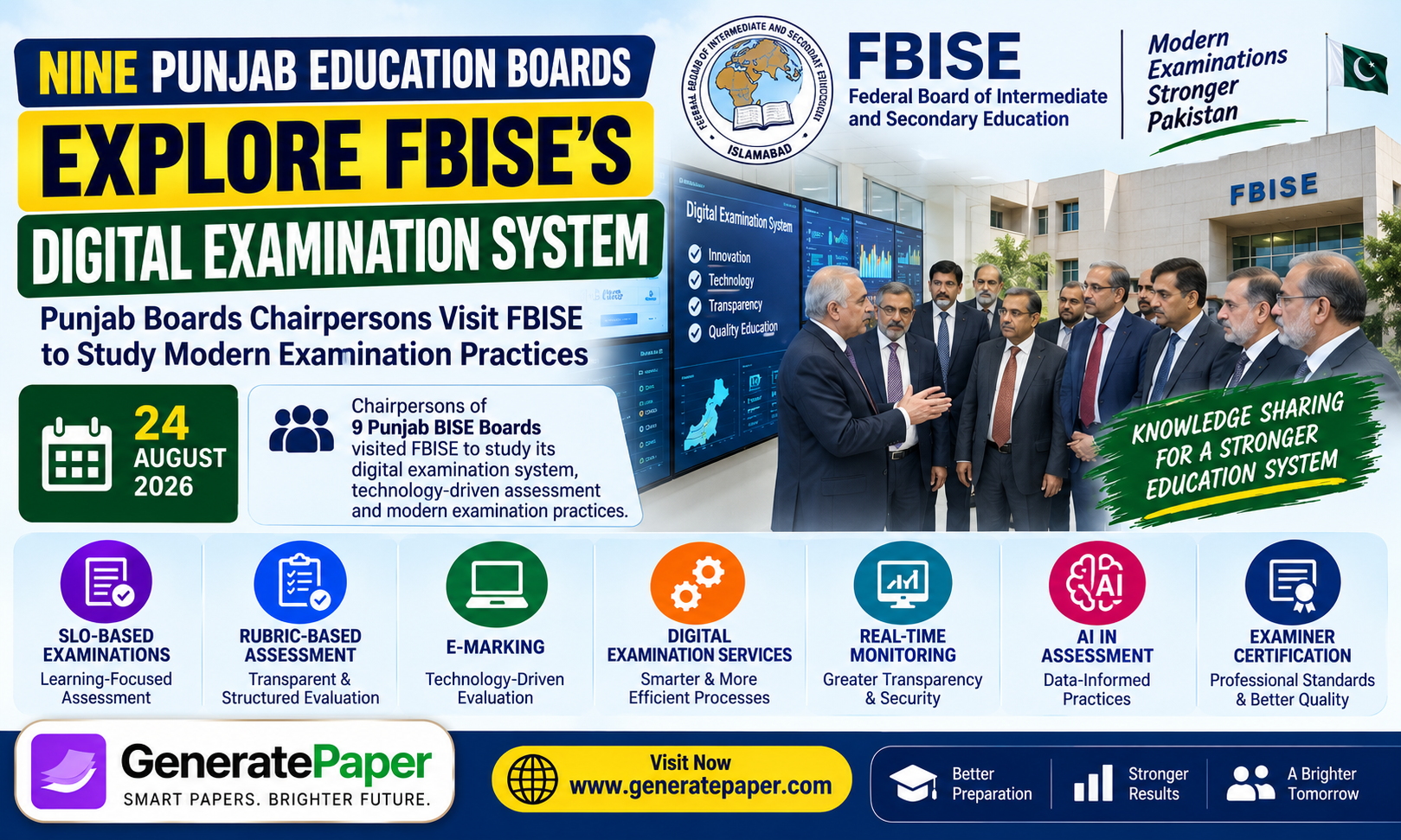
Pakistan's examination system is moving toward greater use of technology, data and modern assessment practices, and a recent visit by Punjab's education boards to the Federal Board of Intermediate and Secondary Education (FBISE) highlights this growing transformation.
On August 24, 2026, chairpersons of all nine Boards of Intermediate and Secondary Education (BISEs) of Punjab visited FBISE in Islamabad to learn from its modern examination, assessment, digitalisation and technology-driven practices. The visit was officially reported by the Government of Pakistan's Press Information Department.
The visit provided an opportunity for professional interaction, knowledge sharing and the exchange of best practices between FBISE and Punjab's education boards.
For students, teachers and educational institutions, the development is important because it indicates increasing interest in digital examination systems and technology-supported assessment across Pakistan.
Why Did the Punjab Boards Visit FBISE?
The Punjab boards visited FBISE to study its examination and assessment practices and explore how modern technology is being used to improve examination quality and efficiency.
According to the official government release, the delegation was briefed about FBISE's examination system and its three major components:
- Test Development
- Test Administration
- Test Evaluation
These areas are supported by modern information technology interventions designed to improve examination processes.
The visit therefore went beyond simply observing computer-based systems. It focused on how technology can support the complete examination cycle, from developing assessment instruments to administering examinations and evaluating student performance.
FBISE's Technology-Driven Examination Practices
During the briefing, Punjab's board chairpersons were informed about several important examination reforms being used or developed by FBISE.
These included:
- SLO-based examinations
- Rubric-based assessment
- E-marking
- Digital examination services
- Real-time monitoring
- Technology-supported examination security
- Data-informed examination practices
These reforms are intended to improve the quality, transparency, reliability and efficiency of examinations.
The development is particularly relevant because modern assessment is increasingly moving away from evaluating students solely on memorisation.
Greater Focus on Student Learning Outcomes
One of the key areas discussed during the visit was Student Learning Outcomes (SLOs).
SLO-based assessment focuses on what students are expected to know, understand and demonstrate after completing a particular part of the curriculum.
This approach can encourage students to develop deeper understanding instead of relying entirely on memorised answers.
FBISE's chairman also emphasised the importance of modern assessment practices in measuring students' learning, competencies and higher-order thinking skills, rather than merely their ability to recall information.
For students, this means effective examination preparation increasingly requires understanding concepts and learning outcomes.
What Is E-Marking?
Another important area highlighted during the visit was e-marking.
E-marking uses digital technology to support the evaluation and marking of examination responses.
Digital marking systems can potentially help examination boards organise scripts, standardise marking procedures and monitor assessment processes more effectively.
The official release identifies e-marking as one of the key reforms discussed with the visiting Punjab boards.
As examination systems become increasingly digital, e-marking could become an important part of how large-scale examinations are evaluated.
Real-Time Examination Monitoring
The delegation also learned about real-time monitoring as part of FBISE's technology-supported examination practices.
Real-time monitoring can provide examination authorities with greater visibility into examination-related activities.
Combined with digital systems, monitoring technologies can potentially support:
- Better examination management
- Faster identification of issues
- Improved coordination
- Greater transparency
- Stronger examination security
The official release specifically lists real-time monitoring among the reforms discussed during the visit.
Artificial Intelligence in Examination and Assessment
One of the most notable elements of the briefing was the discussion of Artificial Intelligence (AI).
According to the Government of Pakistan's press release, FBISE discussed the suggestive use of AI in the first phase of examination and assessment processes.
The potential use of AI was presented as a way to support different stages of the assessment cycle, improve efficiency, assist quality assurance and facilitate evidence-based decision-making.
Importantly, the official release also stresses the importance of academic integrity and appropriate human oversight.
This distinction is important. AI is being discussed as a tool to support examination and assessment processes rather than as a replacement for academic judgment.
Punjab Boards Show Interest in FBISE's Reforms
The visiting chairpersons appreciated FBISE's reforms and expressed interest in adopting relevant practices within their respective boards.
FBISE also assured the Punjab boards of its support, including the sharing of expertise and relevant software solutions.
If such cooperation leads to practical implementation, it could contribute to wider adoption of digital examination practices across Pakistan.
Future Plan for Certified Examiners
Another significant development discussed during the meeting was FBISE's plan to establish a pool of certified examiners.
The plan involves systematic training and certification of examiners with the objective of promoting:
- Consistency in marking
- Reliability in assessment
- Professional standards
- Better quality assurance
The official release states that this initiative is intended to strengthen consistency, reliability and professional standards in assessment and marking.
For students, consistent assessment is important because examination results can influence university admissions, scholarships and future academic opportunities.
What Does This Mean for Punjab Students?
At this stage, students should understand that the visit does not itself announce an immediate change to every Punjab board examination.
The official release says that Punjab board chairpersons visited FBISE to study its practices and expressed interest in adopting relevant reforms.
Therefore, students should not assume that every FBISE examination practice will immediately become applicable to Punjab boards.
Any specific changes to paper patterns, marking schemes, examination procedures or curricula should be followed only when officially announced by the relevant Punjab education board.
What Could Change in the Future?
If Punjab boards adopt suitable practices after studying FBISE's system, students could eventually see greater use of technology in examination processes.
Possible areas of future development could include:
- More digital examination services
- Wider use of e-marking
- SLO-based assessment
- Technology-supported monitoring
- Better standardisation of marking
- Data-informed assessment
- Greater use of digital examination management systems
However, these should be viewed as potential directions, not confirmed changes to Punjab board examinations unless officially announced.
Why This Matters for Teachers
The move toward modern assessment also has implications for teachers.
If examination systems increasingly focus on SLOs, competencies and higher-order thinking, classroom teaching and test preparation may also need to become more concept-oriented.
Teachers can prepare students by:
- Teaching concepts instead of relying only on memorisation
- Connecting questions with learning outcomes
- Using different levels of questioning
- Practising application-based questions
- Conducting regular assessments
- Analysing student performance
Digital tools can also help teachers create more varied practice material.
Digital Tools for Examination Preparation
As Pakistan's examination system becomes more technology-driven, students and teachers can also benefit from digital preparation tools.
GeneratePaper allows users to create practice papers for different subjects and examination requirements.
Students can use generated papers for:
- Revision
- Chapter practice
- Topic-based testing
- MCQ practice
- Mock examinations
- Time management
- Examination preparation
Teachers and academies can also create customised practice papers for their students.
For board examination preparation, visit the GeneratePaper Board Paper Generator.
The goal is not simply to generate more questions, but to provide students with structured opportunities to practise before their actual examinations.
Digital Examination Systems and Transparency
Technology can also play an important role in improving confidence in examination systems.
Digital processes can provide examination authorities with more structured data and monitoring capabilities.
When combined with standardised assessment procedures, trained examiners and appropriate quality controls, technology can contribute to more consistent examination administration.
The official FBISE briefing specifically highlighted the role of technology in enhancing quality, transparency, reliability and efficiency.
Importance of Human Oversight
While AI and digital systems can provide useful support, examination decisions still require appropriate human oversight.
This was clearly reflected in the official discussion of AI at FBISE.
The government's press release notes that AI-enabled solutions could support assessment processes while maintaining academic integrity and appropriate human oversight.
This is particularly important in education because examination results can have long-term consequences for students.
Visit Concludes with FBISE Department Tour
Following the briefing, the Punjab delegation toured various FBISE departments.
The delegates observed selected examination and assessment processes and gained further exposure to the systems being used by the Federal Board.
Both sides also reaffirmed their commitment to continued professional collaboration and the exchange of expertise.
A Step Toward Modernising Pakistan's Examination System
The visit of the nine Punjab BISE chairpersons to FBISE represents an important example of inter-board cooperation and knowledge sharing.
Rather than developing examination reforms independently, education boards can learn from systems that are already being implemented and evaluate which practices may be suitable for their own requirements.
The official government release describes the collaboration as an effort to promote innovation and collectively enhance the quality, credibility and effectiveness of Pakistan's examination and assessment systems.