
Punjab Introduces New Digital Security System for Public and Private Schools
Punjab has directed public and private schools to implement a new digital security system designed to centralize security information and improve monitoring across educational institutions.
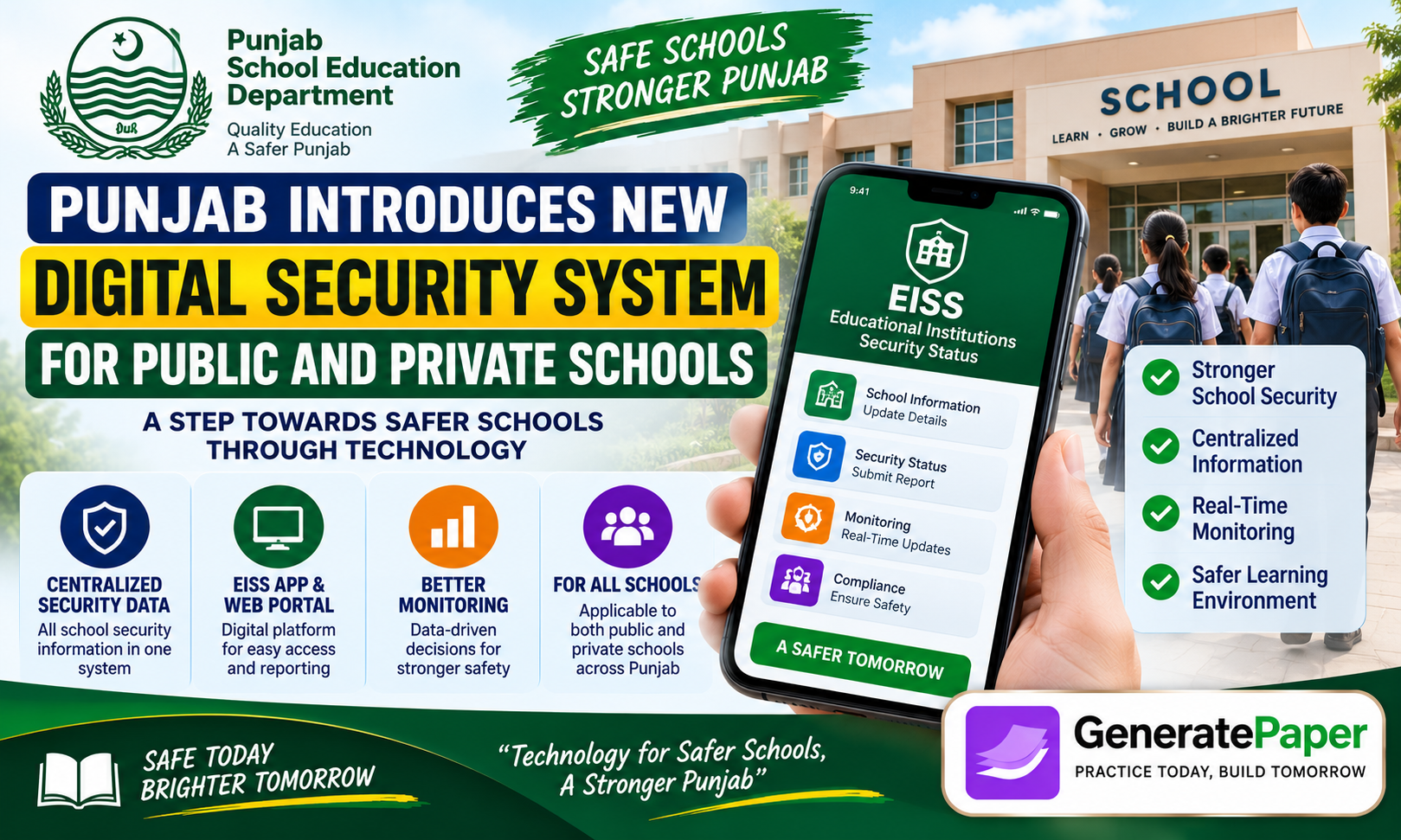
Punjab has taken a new step toward technology-driven school security management, directing public and private educational institutions across the province to implement a centralized digital security system.
The Punjab School Education Department has directed schools to use the Educational Institutions Security Status (EISS) Mobile Application and Web Portal to provide and maintain information related to their security arrangements.
The directive was issued by the Directorate General of Monitoring and Evaluation through a letter dated August 23, 2026, addressed to the Chief Executive Officers of District Education Authorities across Punjab. The CEOs have been instructed to communicate the directions to heads of public and private schools and ensure implementation.
The initiative is intended to create a centralized digital repository of security-related information from educational institutions across the province.
What Is the EISS Digital Security System?
EISS stands for Educational Institutions Security Status.
The system consists of a mobile application and web portal designed to collect, maintain and monitor security-related information from educational institutions.
Instead of relying entirely on separate records maintained by individual schools and administrative offices, the system provides a centralized digital mechanism for recording institutional security information.
According to reports, the initiative was developed following directions from the Punjab Home Department, while the Punjab Information Technology Board (PITB) was assigned responsibility for developing and operationalizing the platform.
Which Schools Will Use the New System?
The directive applies to both public and private educational institutions across Punjab.
This means school administrations in the province are expected to use the designated EISS platform for submitting the required security information.
The District Education Authorities have been instructed to communicate the directions to school heads and ensure compliance.
Why Has Punjab Introduced the Digital Security System?
The main purpose of the initiative is to create a centralized digital record of school security arrangements.
Previously, information relating to security measures could exist across different schools, offices and administrative records.
A centralized digital system can provide education authorities with a consolidated view of security-related information.
The system is intended to support:
- Centralized security records
- Digital monitoring
- Better administrative oversight
- Regular information updates
- Security compliance monitoring
- Data-informed policymaking
- More organized school security management
The department has linked the system with improved monitoring and administrative decision-making.
Schools Must Enter Security Information
School administrations will be required to access the EISS Mobile Application or Web Portal using their official credentials.
They must provide the required information relating to their security arrangements and other mandatory parameters.
Schools have also been directed to ensure that the information submitted is:
- Complete
- Accurate
- Current
- Regularly updated
This requirement is important because the usefulness of a centralized database depends heavily on the quality and accuracy of the information entered into it.
Real-Time Monitoring of School Security
One of the major features associated with the EISS system is digital and ongoing monitoring.
The platform is intended to provide authorities with a centralized view of security information from educational institutions.
This can help officials identify the status of prescribed security measures and improve administrative oversight.
Reports describe the system as an integrated repository that can support real-time monitoring of institutional security information.
Five-Tier Monitoring Mechanism
The EISS initiative is also connected with Punjab's five-tier monitoring mechanism for educational institutions.
The mechanism is designed to create a structured approach to inspecting and monitoring school security arrangements.
At Level-I, educational institutions will conduct a self-assessment through the EISS platform.
This means schools themselves will have an important role in entering and maintaining information about their security arrangements.
The information can then support further levels of administrative monitoring and oversight.
Role of the Punjab Information Technology Board
The Punjab Information Technology Board (PITB) has been assigned responsibility for developing and operationalizing the EISS application.
This highlights the increasing role of digital infrastructure in provincial education administration.
Rather than treating school security only as a physical inspection issue, the new system introduces a technology-based approach for collecting and managing institutional information.
How Could the System Benefit Schools?
The digital security platform could provide several practical benefits for educational institutions and authorities.
1. Centralized Information
Security-related information can be maintained through one centralized digital system.
2. Easier Monitoring
Authorities can have a more organized way to monitor security arrangements across schools.
3. Regular Updates
Schools can update their information when security arrangements or related details change.
4. Better Administrative Oversight
A centralized system can help authorities identify areas requiring attention.
5. Data-Driven Decisions
Collected information can potentially support policymaking and administrative planning.
These benefits depend on accurate implementation and regular updating by educational institutions.
What Does This Mean for Private Schools?
The new system is particularly significant for private educational institutions because the directive covers both government and private schools.
Private school administrations will need to follow the applicable instructions and use the designated EISS platform with their official credentials.
They should ensure that required security information is entered accurately and kept updated.
Schools should also rely on official instructions from the relevant District Education Authority when they need clarification about registration, credentials or specific information requirements.
What Does This Mean for Students and Parents?
The EISS system is primarily an administrative and institutional security monitoring system, rather than a student examination or academic result platform.
For students and parents, its significance is related to the broader management and monitoring of school security arrangements.
A centralized system could help authorities maintain better visibility of whether prescribed security measures are being implemented across educational institutions.
However, students and parents should not assume that the introduction of EISS automatically means a particular security measure has been installed at every school.
The actual security status of an individual institution depends on the information submitted and the applicable monitoring process.
Importance of Accurate School Data
One of the most important aspects of the new digital system is the accuracy of the information entered by schools.
If information is incomplete or outdated, the centralized database may not accurately represent the current security situation.
For this reason, school administrations have been instructed to ensure that their information is complete, accurate, current and regularly updated.
This is a key part of making a digital monitoring system useful in practice.
Digital Transformation Beyond Education
The EISS initiative also demonstrates how digital technology is increasingly being used for public-sector monitoring and administration.
A digital platform can allow government departments to collect information from multiple institutions and organize it within a centralized system.
This approach can potentially reduce dependence on fragmented paperwork and make administrative information easier to manage.
In the education sector, similar digital transformation is already taking place in areas such as examinations, student records, admissions and result verification.
Connection With Modern Education Technology
Technology is no longer limited to online classes and learning apps.
Modern education technology increasingly includes:
- Digital examination systems
- Online student records
- Digital result cards
- E-marking
- Digital assessment
- School management systems
- Security monitoring platforms
- Data-driven educational planning
The introduction of EISS adds institutional security monitoring to this wider digital transformation.
How Digital Tools Can Help Students
While EISS is designed for institutional security management, students can also benefit from other digital education tools.
For examination preparation, GeneratePaper allows students and teachers to create structured practice papers.
Students can use practice papers for:
- Subject revision
- MCQ practice
- Chapter testing
- Mock examinations
- Time management
- Exam preparation
Teachers and academies can also use digital paper-generation tools to prepare customized tests for students.
For board-focused preparation, students can explore the GeneratePaper Board Paper Generator.
What Schools Should Do Now
Schools covered by the directive should take the implementation requirements seriously.
School administrations should:
- Access the EISS platform using official credentials.
- Enter the required security information.
- Ensure all submitted information is accurate.
- Keep the information updated.
- Follow instructions issued by the relevant District Education Authority.
- Maintain proper internal records of their security arrangements.
- Use only official channels for EISS-related communication.
Schools should avoid relying on unofficial social-media posts for important implementation instructions.
Is This a New Security App for Students?
Not exactly.
The EISS system is primarily designed for educational institutions and administrative authorities.
It is intended to collect and monitor information about school security arrangements rather than provide students with a personal security application.
This distinction is important because the system's main purpose is institutional monitoring and administrative oversight.
A Step Toward Data-Driven School Security
The introduction of EISS represents a move toward using centralized data to support school security management.
When information from schools is maintained digitally and regularly updated, authorities can potentially gain a clearer picture of security arrangements across the province.
This can help support better monitoring, planning and administrative decisions.
The department has specifically connected the platform with data-driven policymaking related to educational institution security.