Punjab University Holds Special AI Training Sessions for University Administrators
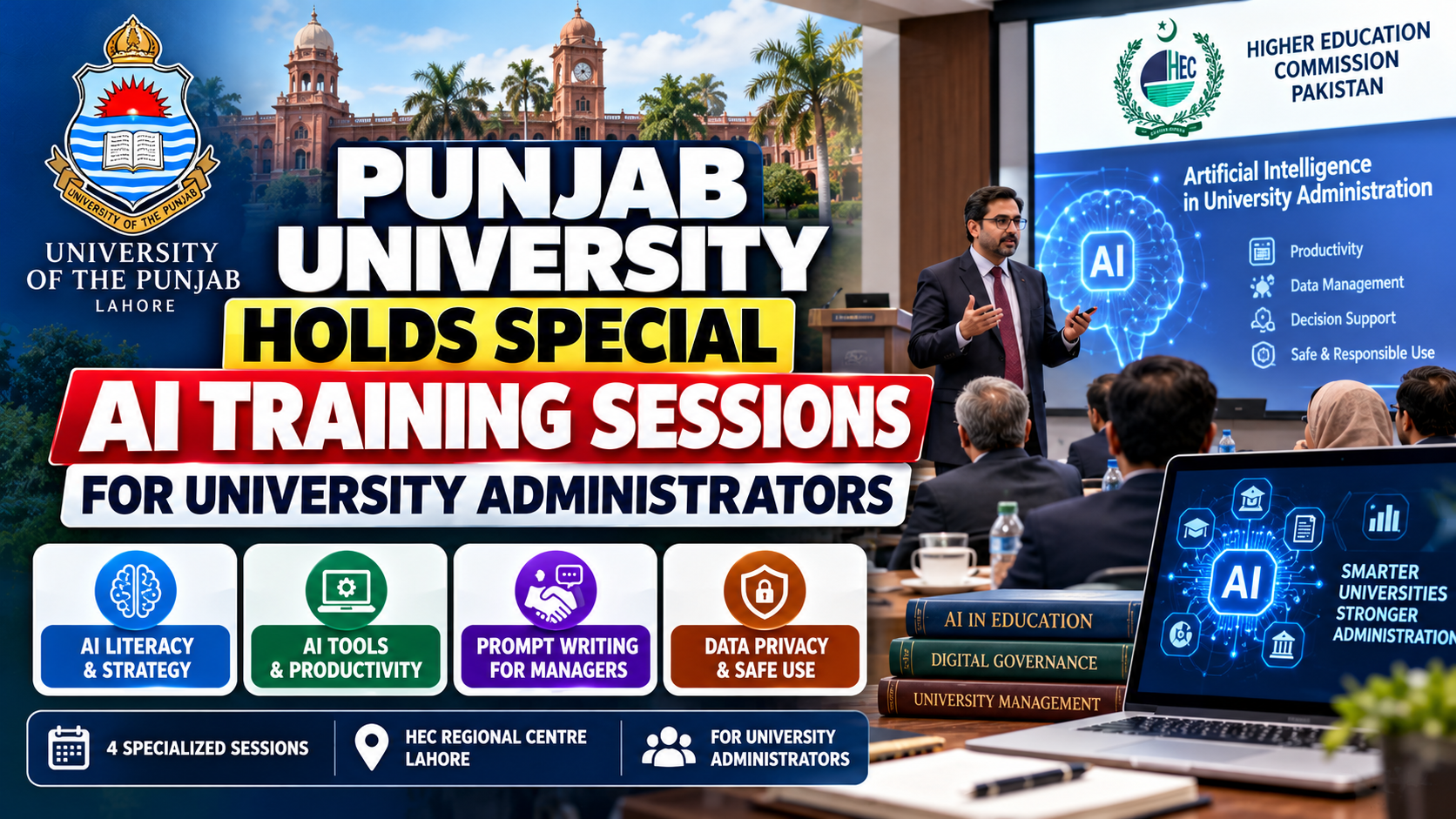
Punjab University professor conducts four specialized AI training sessions for university administrators at HEC Lahore, focusing on AI literacy, productivity and safe AI use.
University of the Punjab has contributed to a national initiative aimed at strengthening Artificial Intelligence (AI) skills among university administrators in Pakistan.
Prof. Dr. Syed Waqar ul Qounain Jaffry, Chairman of the Department of Information Technology at the Faculty of Computing & Information Technology (FCIT) and Director of the National Centre of Artificial Intelligence (NCAI-PU), conducted four specialized training sessions for university administrators at the Higher Education Commission (HEC) Regional Centre Lahore on October 28, 2026.
The sessions were part of a three-day professional development programme titled “Applied Artificial Intelligence for University Administration,” organized by HEC in collaboration with the National Academy of Higher Education (NAHE).
The initiative focuses on helping university management and administrative officers understand how AI can be used responsibly to improve institutional efficiency, administrative productivity, information management and service delivery.
Four Specialized AI Training Sessions
Prof. Dr. Jaffry served as the resource person for the first day of the programme, which focused on “AI Literacy, Strategy and Safe Use.”
The training consisted of four interconnected sessions designed specifically for professionals working in university administration.
1. AI and the Changing University
The first session introduced participants to the foundations of artificial intelligence and its growing role in higher education.
Participants were introduced to concepts including:
-
Artificial Intelligence
-
Machine Learning
-
Deep Learning
-
Generative AI
-
Emerging AI capabilities
The session explored how these technologies are changing university operations and creating new opportunities for administrative work.
2. AI Tools, LLMs and Productivity Assistants
The second session focused on the growing landscape of AI tools and Large Language Models (LLMs).
Participants explored potential applications of AI in routine university tasks, including:
-
Official correspondence
-
Document preparation
-
Report writing
-
Information retrieval
-
Knowledge organization
-
Administrative decision support
The emphasis was on practical applications that can help university offices manage routine and knowledge-intensive work more efficiently.
3. Prompt Writing for Managers
The third session introduced participants to effective prompt writing.
Prompt writing refers to the process of giving clear and structured instructions to an AI system in order to obtain more useful and relevant responses.
Through demonstrations and guided exercises, administrators learned how to communicate effectively with AI systems for professional and administrative tasks.
This skill is increasingly important as universities explore ways to incorporate AI into everyday workflows.
4. Data, Privacy and Safe AI Use
The fourth session addressed one of the most important issues surrounding AI adoption: responsible and secure use of AI.
The session covered areas including:
-
Information confidentiality
-
Data protection
-
Cybersecurity awareness
-
Verification of AI-generated information
-
Institutional accountability
-
Human oversight in decision-making
The training emphasized that AI should support human expertise rather than replace professional judgment, particularly when dealing with confidential institutional information or official decisions.
Practical AI Training for University Administration
A major feature of the programme was its practical approach.
Rather than focusing only on theoretical explanations, participants worked with:
-
Practical demonstrations
-
Hands-on exercises
-
Realistic administrative scenarios
-
Sample documents
-
Guided problem-solving activities
The participants explored how AI could assist university offices with routine administrative tasks, document preparation, report writing, information management and other knowledge-based activities.
The training also highlighted the limitations of AI-generated content.
Participants were encouraged to verify AI-generated information against authentic institutional records and applicable rules before using it for official purposes.
Why AI Training Is Important for University Administrators
Artificial intelligence is increasingly being used in education and organizational management.
While much attention is often given to AI in teaching, research and student learning, university administration is another area where AI can potentially improve efficiency.
Administrative departments handle large amounts of information every day.
These departments may be responsible for:
-
Student records
-
Admissions
-
Examination information
-
Official correspondence
-
Reports
-
Scheduling
-
Data management
-
Institutional documentation
-
Communication with students and staff
AI tools can potentially assist with some of these activities, provided they are used responsibly and under appropriate human supervision.
AI and Administrative Productivity
One of the key objectives of the training was to demonstrate how AI could improve administrative productivity.
For example, AI-assisted tools may help administrators organize information, prepare draft documents, summarize lengthy material or structure reports.
However, the training emphasized that AI-generated outputs should not automatically be treated as accurate.
Human review remains essential before information is used for official university decisions or communications.
Data Privacy and Confidentiality
Data privacy is particularly important in university environments.
Universities manage sensitive information relating to:
-
Students
-
Faculty
-
Employees
-
Academic records
-
Financial information
-
Research
-
Institutional operations
The training therefore emphasized the importance of protecting confidential information when using AI tools.
Administrators need to understand what information can safely be entered into an AI system and what information should remain within approved institutional systems.
Human Oversight Remains Important
The programme also emphasized that artificial intelligence should augment human expertise.
AI can assist with productivity and information processing, but final decisions involving institutional policies, regulations, students, employees or confidential information require appropriate human judgment.
This approach is particularly important in higher education, where administrative decisions can directly affect students, faculty and institutional operations.
Supporting AI Adoption Across Higher Education
The training forms part of wider efforts to strengthen AI capabilities across Pakistan's higher education sector.
Earlier in October 2026, HEC's National Academy of Higher Education announced a three-day programme on Applied Artificial Intelligence for University Administration, aimed at university management and administrative officials. The programme was designed to provide practical exposure to AI applications in areas such as admissions, examinations and record management.
HEC also indicated that similar training activities would subsequently be extended through its regional centres in Lahore, Karachi, Peshawar and Quetta.
This indicates a broader effort to develop AI-related administrative capabilities beyond individual universities.
Training Materials and Continued Learning
According to the University of the Punjab, the training was supported by structured learning resources.
These included:
-
Session presentations
-
Participant workbooks
-
Guided exercises
-
Worked examples
-
Administrative prompt templates
-
Synthetic datasets
-
AI governance resources
-
Safe-use materials
These resources are intended to help participants continue practicing AI-assisted administrative tasks after the training sessions.
Punjab University's Role in AI Development
Punjab University has been involved in several initiatives related to artificial intelligence and digital skills.
The university's Faculty of Computing & Information Technology and National Centre of Artificial Intelligence have contributed to AI-related research, training and capacity-building activities.
In this latest initiative, the university contributed academic and professional expertise to a national-level training programme focused specifically on university administration.
The university stated that participation in such initiatives supports the dissemination of advanced technological knowledge and the responsible application of AI for institutional improvement.
AI Adoption Must Be Responsible
The increasing availability of AI tools creates opportunities for universities, but it also introduces new responsibilities.
Institutions need to consider:
Accuracy
AI-generated information should be checked before official use.
Privacy
Confidential institutional and personal data should be protected.
Cybersecurity
Administrators should understand the security risks associated with AI tools.
Accountability
Human officials remain responsible for institutional decisions.
Ethical Use
AI should be used in ways that respect institutional policies and professional standards.
The training at HEC Lahore placed particular emphasis on these issues.
What This Means for Pakistan's Universities
The initiative reflects the growing importance of AI literacy not only among students and teachers but also among university management professionals.
As higher education institutions increasingly adopt digital systems, administrators need the skills to understand and evaluate emerging technologies.
AI training can help university personnel identify appropriate use cases while also understanding the limitations and risks of these tools.
The long-term objective is not simply to introduce AI into university offices, but to ensure that it is adopted effectively, safely and responsibly.
Key Areas Covered in the Training
| Training Area | Main Focus |
|---|---|
| AI Literacy | Understanding AI, ML, Deep Learning and Generative AI |
| AI Tools | LLMs and productivity assistants |
| Prompt Writing | Effective instructions for AI systems |
| Data Privacy | Confidentiality and data protection |
| Cybersecurity | Safe use of AI tools |
| Verification | Checking AI-generated information |
| Administration | Reports, documents and information management |
| Human Oversight | Responsible decision-making |
What University Administrators Can Learn From AI Training
University administrators can potentially use AI skills to improve several aspects of their daily work.
Document Preparation
AI can assist in preparing drafts and organizing information.
Report Writing
Administrators can use AI-assisted tools to structure reports and summarize information.
Information Management
AI can help organize and retrieve large amounts of information when used with appropriate systems.
Communication
AI can assist with drafting professional correspondence.
Productivity
Routine tasks can potentially be streamlined, allowing staff to focus more on complex responsibilities.
However, all such applications require appropriate institutional policies and human review.
The Future of AI in Higher Education Administration
AI is likely to become increasingly relevant to university management.
The future may involve greater use of AI-assisted systems for:
-
Student services
-
Administrative workflows
-
Information management
-
Institutional reporting
-
Digital communication
-
Data analysis
-
Decision-support systems
However, universities will need to balance technological innovation with privacy, security, ethics and human accountability.
The HEC–NAHE training programme represents one step toward developing that balance.