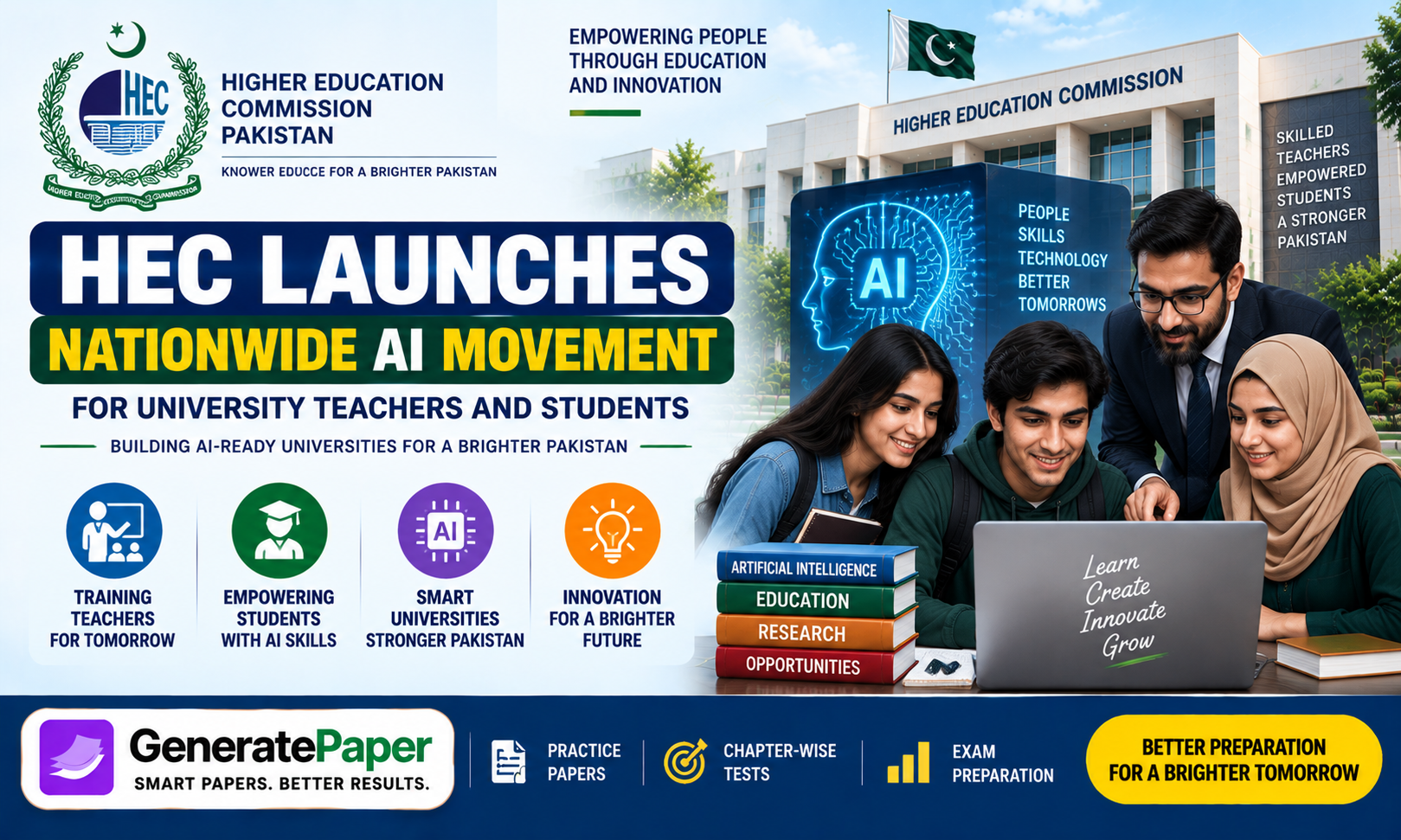
HEC Trains Over 332 Faculty Members on Artificial Intelligence to Build AI-Ready Institutions
HEC Pakistan has trained over 332 university faculty members in AI literacy, covering AI-based teaching, assessment, research, academic practices and responsible AI use.
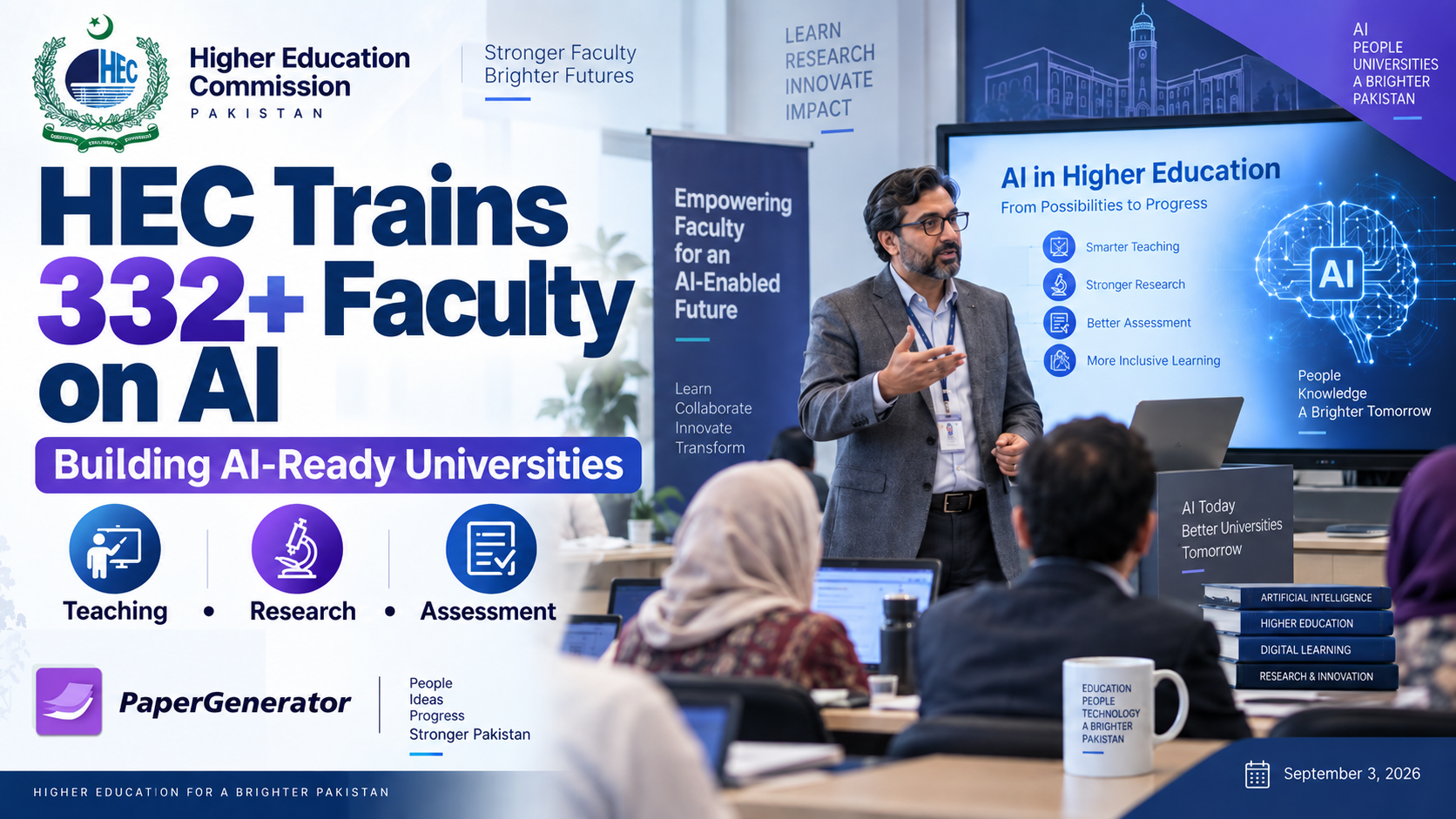
HEC Trains Over 332 Faculty Members on Artificial Intelligence to Build AI-Ready Institutions
The Higher Education Commission (HEC) Pakistan has taken another significant step toward strengthening the use of artificial intelligence in universities by training more than 332 faculty members through a dedicated AI literacy programme.
The four-day faculty development programme, titled “AI Literacy for Educators: Building AI-Ready Institutions,” was organised by HEC's National Academy of Higher Education (NAHE) and concluded in Islamabad on September 3, 2026.
According to HEC, 32 faculty members from public-sector higher education institutions in Islamabad and Rawalpindi attended the programme physically at the HEC Smart Classroom. More than 300 additional faculty members participated remotely through university Smart Classrooms and video-conference facilities across Pakistan.
The initiative focused not simply on learning how to use AI tools, but on helping university teachers understand how artificial intelligence can responsibly support teaching, learning, research, assessment and wider academic practices.
What Was the HEC AI Training Programme?
The training was designed primarily for lecturers and assistant professors serving in public-sector higher education institutions.
Rather than offering only technical demonstrations, HEC says the programme combined conceptual learning, practical exercises, critical reflection and real academic applications of artificial intelligence.
The goal was to help university educators develop both foundational AI knowledge and practical skills they could use in their professional work.
Faculty members participated through HEC's Smart Classroom network, allowing university teachers from different locations to join live sessions and interact with the trainer in real time.
This technology-enabled approach enabled HEC to reach hundreds of faculty members without requiring everyone to travel to Islamabad.
Students and teachers can read the original announcement through the official HEC news release on AI faculty training.
More Than 332 Faculty Members Participated
One of the most notable aspects of the programme was its scale.
HEC reported that 32 faculty members attended in person, while more than 300 participated online through Smart Classrooms and video-conference facilities at their respective universities.
That means participation exceeded 332 faculty members.
The programme demonstrates how universities can use existing digital infrastructure to provide professional development across multiple institutions simultaneously.
For Pakistan's higher education sector, this approach may become increasingly relevant as universities work to introduce new technologies while ensuring that faculty members receive appropriate training.
What Did Faculty Members Learn?
The programme covered a broad range of AI applications relevant to university teaching and academic work.
HEC reported that participants received practical exposure to AI-supported curriculum and course design, lesson planning, development of teaching resources, academic writing, research assistance, assessment design, student feedback, data analytics, communication and professional productivity.
Participants also explored contemporary AI tools and learned about prompt engineering and effective human-AI interaction.
These areas are important because educators are increasingly encountering AI not only in their own work but also in student assignments, research and assessment.
Universities therefore need faculty who understand both the opportunities and the limitations of these technologies.
AI in Teaching and Lesson Planning
Artificial intelligence can support teachers during different stages of course preparation.
For example, educators may use AI to brainstorm lesson structures, generate examples, prepare discussion questions, develop practice activities or adapt instructional material for different learning needs.
However, AI-generated material should still be reviewed by a qualified teacher before being used with students.
The HEC programme emphasised critical understanding rather than treating AI outputs as automatically reliable.
This distinction is especially important in education because inaccurate AI-generated information can affect teaching quality and student learning.
AI and University Assessment
Assessment is another area where artificial intelligence is becoming increasingly relevant.
Faculty members can potentially use AI when planning assessment activities, developing question ideas, preparing rubrics or analysing learning patterns.
But assessment also raises important issues involving academic integrity, fairness and appropriate human oversight.
During the programme, NAHE Managing Director Dr. Noor Amna Malik stressed that universities must maintain academic quality, ethical principles, human judgment and institutional responsibility while integrating artificial intelligence.
For teachers who regularly prepare classroom tests and practice assessments, digital tools can reduce repetitive preparation work. The GeneratePaper online paper generator allows educators to select a board, class, subject, chapters or topics and create structured printable papers. GeneratePaper currently supports MCQs, short questions, long questions, comprehension and mixed papers.
AI in Academic Research
Research was another important component of the HEC training.
Artificial intelligence can support researchers in areas such as idea organisation, literature exploration, data analysis, drafting assistance and productivity.
However, academic researchers must remain responsible for verifying information, protecting confidential data and maintaining research integrity.
HEC's programme specifically highlighted the need for faculty members to critically evaluate AI-generated outputs and protect privacy and intellectual property.
This is particularly important because AI-generated text can appear convincing even when information is incomplete or incorrect.
HEC Emphasises Ethical and Responsible AI Use
A central message of the programme was that AI literacy means more than knowing how to operate an AI tool.
Dr. Noor Amna Malik emphasised the importance of understanding AI systems, including their capabilities, limitations and implications for academic work.
Faculty members were encouraged to maintain human oversight and consider academic integrity, privacy, intellectual property and ethical responsibilities when using AI in teaching, assessment and research.
This approach closely reflects international discussions about responsible AI in education.
UNESCO's AI Competency Framework for Teachers identifies five major areas of teacher competency: a human-centred mindset, AI ethics, AI foundations and applications, AI pedagogy and AI for professional learning.
Educators interested in the broader international framework can read the UNESCO AI Competency Framework for Teachers.
Why AI-Ready Institutions Need Trained Faculty
An institution cannot become AI-ready simply by purchasing software or providing access to AI tools.
Faculty members need to understand when AI is useful, when it may introduce risks and when human judgment should remain central.
HEC's training highlighted that meaningful AI integration requires capable faculty members, institutional preparedness, governance mechanisms, ethical safeguards and ongoing professional development.
This means universities may need to think beyond individual AI applications and develop institution-wide approaches to training, academic integrity, assessment and responsible use.
HEC's Wider Focus on Artificial Intelligence
The faculty training programme is part of a broader HEC focus on preparing Pakistan's higher education sector for artificial intelligence.
Earlier in 2026, HEC Chairman Dr. Niaz Ahmad Akhtar said that a three-credit-hour Artificial Intelligence course had been made mandatory for undergraduate programmes to provide students from different disciplines with foundational knowledge of emerging technologies.
In July 2026, HEC also reported that approximately 6,000 students completed the ACT AI Cycle-1 programme through the HEC Smart Classroom network.
Together, these initiatives indicate that HEC's AI strategy involves both students and faculty.
What This Means for University Teachers
University educators are increasingly expected to understand how AI affects teaching, assessment, research and student learning.
Practical AI literacy can help teachers make better decisions about when technology should be used and when traditional academic methods remain more appropriate.
For educators creating regular quizzes, assignments and examinations, technology can also reduce administrative workload when it is used carefully.
Teachers interested in streamlining paper preparation can review How GeneratePaper Works, which explains its board-to-class-to-subject workflow, chapter and topic selection, paper-type configuration and printable PDF generation.
The important principle is that automation should assist educators rather than replace academic judgment.
The Growing Importance of AI Literacy in Higher Education
Artificial intelligence is already influencing how educational content is created, how students complete assignments and how researchers work with information.
Faculty development therefore becomes essential.
Teachers need sufficient AI knowledge to evaluate student use of AI, redesign assessment where necessary, verify machine-generated information and guide students toward responsible use.
UNESCO similarly notes that educators need knowledge, skills and values covering both AI applications and their ethical use.
This makes AI literacy increasingly relevant across disciplines—not only computer science.